Tag: harmful practices

Afrah Qassim, CEO and Founder of Savera UK and Police and Crime Commissioner for Cheshire, John Dwyer

Cheshire PCC and Savera UK launch partnership

Police and Crime Commissioner for Cheshire, John Dwyer has joined forces with Savera UK to support its work in providing life-saving services for those at risk of ‘honour’-based abuse (HBA) and culturally specific abuse in Cheshire.

Through funding provided by the Commissioner, the charity has been able to employ a HBA and Harmful Practices Specialist Worker to join Savera UK 1-1 service team to provide direct intervention to survivors and those at risk or under threat of ‘honour’-based abuse and harmful practices.

Police and Crime Commissioner for Cheshire, John Dwyer, said: “I am delighted to be working with Savera UK, the direct intervention, safeguarding and advocacy that they provide to communities across Cheshire is vital. ‘Honour’-based abuse is often under-reported and can

Afrah Qassim, CEO and Founder of Savera UK and Police and Crime Commissioner for Cheshire, John Dwyer
Afrah Qassim, CEO and Founder of Savera UK and CEO of Cheshire PCC Office, Damon Taylor

be referred to as a ‘hidden-crime’ because of this. By having Savera UK’s provision in our county, it may just give people the confidence they need to come forward and report their experiences.

“Protecting vulnerable and at-risk people is a priority in my Police and Crime Plan, and those at risk of ‘honour’-based abuse can be some of the most vulnerable in our society. I am looking forward to working alongside Savera UK to ensure survivors get the safeguarding and support that they need in order to rebuild their lives.”

As well as the direct intervention, safeguarding and advocacy that Savera UK provides to  survivors we will also be providing them with emotional support, an empowerment programme and assistance in gaining economic independence.

Savera UK also aims to tackle the causes of ‘honour’-based abuse and harmful practices by speaking out to challenge harmful attitudes, contributing to research and delivering training to raise awareness among professionals and in the wider community.

CEO and Founder of Savera UK, Afrah Qassim, said: “Partnerships are vital in our mission to eradicate ‘honour’-based abuse and harmful practices and we are proud to be working with the Cheshire Police and Crime Commissioner to tackle these issues in the county.

“Guiding and supporting people working on the frontline to better understand harmful practices, speak out against them, and provide appropriate help to survivors and those at risk enables us to reach more people who otherwise may not have found the confidence to seek help.

“Meeting the team to formally launch our partnership was a wonderful experience and its commitment to tackling these issues shone through. We look forward to working with Cheshire PCC in our united aims and making it clear that there is no excuse for abuse regardless of people’s beliefs.”

There are many signs of ‘honour’-based abuse and other harmful practices, indicators can include:

  • House arrest- being kept home with no choice of freedom or movement
  • Threats to kill- those who believe in HBA would like their loved one in the name of ‘honour’, so threats must be taken seriously
  • Being accompanied at all times by a family member- they may even speak on their behalf
  • Becoming withdrawn or displaying a change in behaviour
  • Family disputes
  • Presenting a fear of being taken abroad

John Dwyer added: “I want to take this opportunity to encourage anyone who is experiencing or witnessing ‘honour’-based abuse to speak out. Speaking out isn’t easy but it takes us step closer to eradicating harmful practices within our communities. Savera UK is there to help and support you, but I would like to remind the public that 999 should always be the first contact if there is an immediate risk.”

The Savera UK helpline is open weekdays 10am-4pm on 0800 107 0726, there are also online referral forms for individuals and professionals available in the “Get Help” section of the website.

A title image which reads 'Savera UK study reveals core elements of 'honour'-based abuse in the UK

Savera UK study reveals core elements of ‘honour’-based abuse in the UK

Emotional/psychological abuse and coercive control has been identified as the most common characteristic of ‘honour’-based abuse (HBA) and harmful practices, in new research conducted by the University of Liverpool and Savera UK.

The research ‘Honour’-based abuse: A descriptive study of survivor, perpetrator, and abuse characteristics[1], published last month in the Journal of Investigative Psychology and Offender Profiling, examines survivor, perpetrator, and abuse characteristics in anonymised cases of HBA and harmful practices such as forced marriage and female genital mutilation (FGM), provided by Savera UK.

Much information on HBA currently available is based on self-reporting and exploration of individuals’ lived experience, meaning baseline data to help better understand the issues is limited. The study was instigated by Savera UK to fill this gap, working in partnership with the University of Liverpool and using the charity’s own data to identify base rates of survivor, perpetrator, and abuse characteristics.

Of 66 abuse characteristics identified by researchers, the study highlighted that a case of HBA would usually present with around 14 of these characteristics.

Emotional/psychological abuse and coercive control, specific family cultural traditions, gender-based socialisation and physical violence were found to be present in 90% of coded cases, suggesting these to be core elements of HBA in the UK.

Abuse characteristics associated with survivors that are usually highly linked to cases of HBA, such as exploration of identity or sexuality, were present less frequently than expected. For example, premarital sex, which features highly in literature about HBA based on self-reported data and survivor stories, was only present in 20 cases.

This study was able to explore broader and subtler forms of abuse, as the data reflected not only survivor experiences, but also the professional judgement of Savera UK support staff specialising in this field.

It also highlighted overlaps between HBA and domestic abuse, as well as clear separating markers, such as the presence of multiple perpetrators, specific family cultural traditions and community influencing the perpetrator(s).

In its examination of survivor characteristics, the study found that almost half (41.4%) held UK citizenship, 27.8% asylum seekers and 18.1% had limited or indefinite leave to remain. The majority were Muslim (74.8%) but Christianity was the second most prevalent religion among survivors with (14.2%).

Almost two thirds of cases had multiple perpetrators (63.1%) and all involved male perpetrators, with additional female perpetrators in 36.4% of cases. However, no cases involved a sole female perpetrators.

Speaking of Savera UK’s first-ever research paper, Afrah Qassim, CEO and Founder of the charity, said: “The lack of data around HBA and harmful practices has always been a challenge for organisations like Savera UK that support survivors and those at risk.

“When we established the charity in 2010 many local authorities told us there was no need for our service because there was no data indicating that HBA was an issue. Since then we have worked to uncover these hidden practices and demand for our service has increased by more than 1,000 per cent between 2016 and 2022.”

“This baseline data is vitally important and a starting point to allow better understanding of the prevalence of different abuse characteristics and improved insight into HBA in the UK. This information will help frontline workers like police officers and social workers to more easily identify and support survivors and those at risk, develop specialist HBA risk assessment tools, improve prevention strategies and inform where further research is urgently needed to help tackle these issues.”

Professor Louise Almond, from the University of Liverpool, said: “This base rate study highlights the wide range of abuse suffered by ‘honour’-based abuse survivors. What was most surprising was the low prevalence of characteristics that have been previously linked with ‘honour’ based abuse in Western media. Our study reflects a potentially different “reality” for these survivors, one which is more nuanced than maybe the public and/or statutory agencies realise”

To read the full paper visit: https://onlinelibrary.wiley.com/doi/10.1002/jip.1602

[1]  K.Ridley, L.Almond, N.Bafouni, A.Qassim (2022) ‘Honour’-based abuse: A descriptive study of survivor, perpetrator, and abuse characteristics, Journal of Investigative Psychology and Offender Profiling https://onlinelibrary.wiley.com/doi/10.1002/jip.1602

Savera UK Clients Celebrate International Women’s Day 2022

In March, Savera UK marked International Women’s Day by holding a celebratory lunch for our amazing clients, who continually overcome hurdles in the face of adversity and are testament themselves of how we can #BreakTheBias caused by gender inequality.

Savera UK clients include both those at risk of, and survivors of, ‘honour’-based abuse (HBA), forced marriage, female genital mutilation (FGM) and other harmful practices. These practices are violations of human rights and are borne from deep-seated patriarchal ideologies which oppress women.

While Savera UK supports people of all genders, the majority of our clients are women, which is why it’s important for us to celebrate International Women’s Day and the strides that continue to be made to eliminate harmful practices and gender-based abuse.

To celebrate the day, Savera UK brought together the women we support for a Middle Eastern banquet where we celebrated their strengths, while looking towards a brighter future for all women.
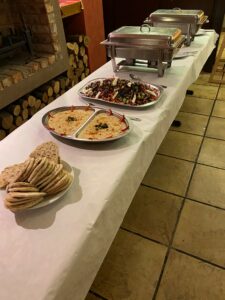
Savera UK clients enjoyed a delicious feast at the International Women’s Day celebration

Speaking about  the lunch, one Savera UK client said: “I enjoyed that I was able to meet together with other women who are from diverse backgrounds and to watch how they felt happy with the gathering.” She also added: “I felt honoured for being valued on that day.”

Savera UK support worker Emma said: “It is important to remember how fantastic women are and to celebrate our strengths on a day like International Women’s Day.

“It counters the narrative that many of our clients have been led to believe within their communities, which can hold misogynistic and harmful attitudes towards women. It is great to help them build their confidence and see their strengths that have often been overlooked or even shamed.”

Describing the atmosphere at the lunch, Emma said: “it felt like a celebration, it was lovely, united and positive” adding that it was “very rewarding to be able to offer some normality” and “made all the preparation worth it”.

Unfortunately social work student Taylor, who helped organise the event was unable to attend, but we would like to thank her for her work in bringing together the event.


St George's Hall lit up orange for the last Orange the World campaign

Savera UK partner with Zonta London for Orange the World 2021

For the second year, Savera UK and Zonta London are joining forces for Orange the World 2021.

The campaign will see landmark structures lit orange to mark 16 days of activism from Thursday, 25th November to Friday, 10th December. During the 16 days, we will raise awareness of violence against women and girls in the UK and around the world.

St George's Hall lit up orange for the last Orange the World campaign
St George’s Hall lit up orange for the last Orange the World campaign (Image credit: Jennifer Bruce)

We are speaking out against domestic violence, rape and harassment, as well as more hidden harmful practices like ‘honour’-based abuse, female genital mutilation and forced marriage. We want to rally people to take action that will ensure that our towns, cities and homes are places where women and girls can live without fear of violence, abuse or harassment. There is no excuse for abuse.

To help you get involved in the 16 days of activism, this year we are releasing a toolkit with themes, activities and events you can participate in. We will also include information on the services available to those at risk.

To be the first to receive the toolkit and find out more about the event, please register your interest here.

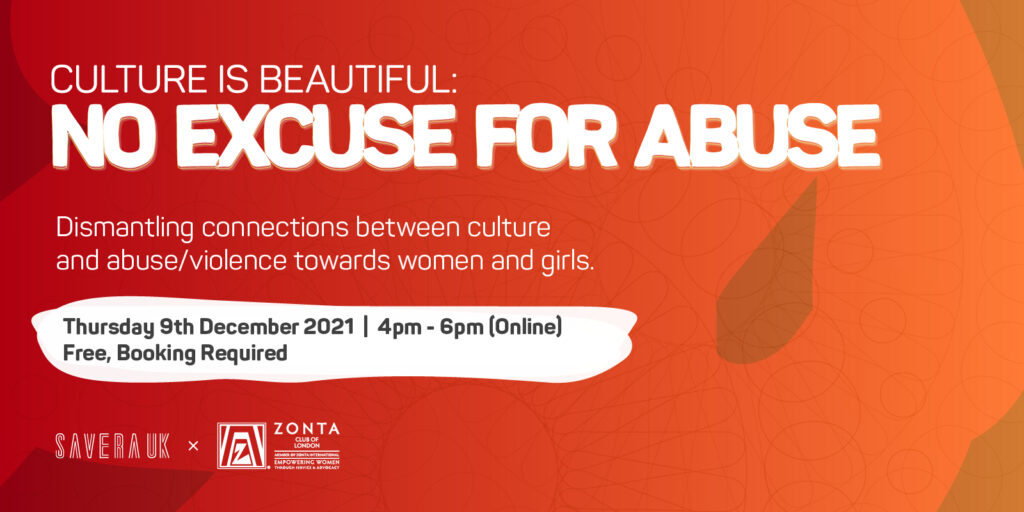
Culture is Beautiful: No Excuse for Abuse panel event

Culture is Beautiful: No Excuse for Abuse
The Culture is Beautiful: No Excuse for Abuse panel event will take place on Thursday, 9th December 2021 between 4pm and 6pm.

During the Orange the World campaign Savera UK and Zonta International will host a powerful online panel event titled Culture is Beautiful: No Excuse for Abuse.

On Thursday, 9th December between 4pm and 6pm, an exciting and influential international panel will come together to discuss how cultures and cultural beliefs, including religion, are used as an excuse for male violence against women/girls and harmful practices.

They will also highlight the misinformation that perpetuates this belief and how such harmful practices are in fact a violation of human rights that need to be tackled. The panel will also discuss how we can work together to end harmful traditional practices.

Savera UK CEO and founder, Afrah Qassim and a representative of Zonta International will be joined by a panel including; Mansi Mehta, Deputy Director, Global Cause Partnerships from UNICEF USA, Dr Elham Manea from Zurich University, a political scientist specialised on the Arab Middle East, Nazir Afzal, former Chief Prosecutor for the North West (UK) and Savera UK patron, as well as other speakers yet to be confirmed.

The event will share the voices of survivors and attendees will be able to put their questions to the panel in a Q&A session. If you would like to attend the free, online event, you can register here.